Introduction
This course focuses on the seismic analysis of
Project Information
Mars Properties is one of the largest privately held real estate investors and managers in the world. The company is developing a new 42-story mix use building in downtown Salt Lake City, Utah (US). The building will provide retail space on the first two floors, office suites on 15 floors, and residential spaces with a mix of studio, 1-bedroom, 2-bedroom, and 3-bedroom apartments for the rest of the floors. The top 3 floors contain private luxury residences utilizing the entire floor area.
The site of this proposed building is currently occupied by an old burger joint which has run out of business in 2019. The site is surrounded by low and mid-rise buildings offering a mix of retail, office, and residential spaces.
Building Details
The Salt Tower is a 42-story building (Figure 1) located in downtown Salt Lake City. Since, it is a residential tower, it was decided to use concrete for the structural system to utilize higher inherent damping under wind and service loads. The gravity structural system of the building comprises of concrete post-tensioned slabs supported on concrete columns and a central concrete core. The concrete core at the center of the building, used for elevator and stair, provides the stiffness and strength against the seismic forces. The concrete slabs and the core make up the seismic-force-resisting system of the building. The gravity and the lateral forces are transferred to the ground via a thick concrete mat.
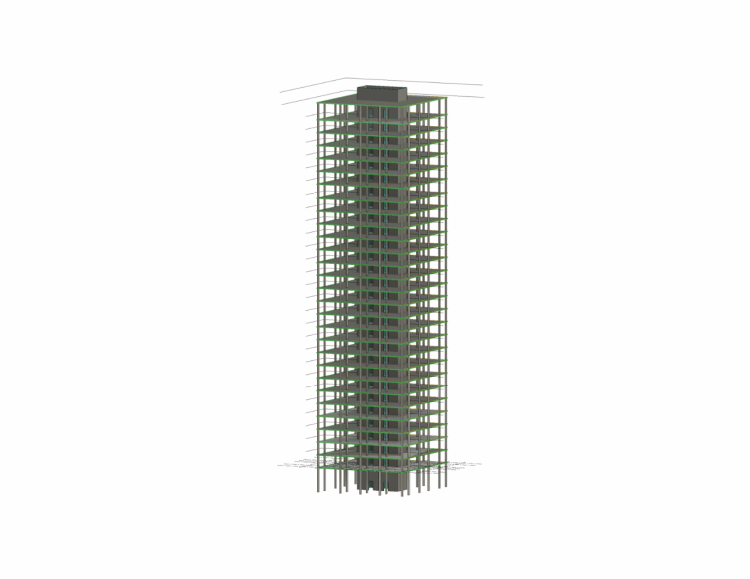
The building is located in high seismic region of the Rocky Mountains with the most active Wasatch fault about 8 miles away from the site, capable of producing a magnitude 7.5 earthquake. This geological location of the site makes the building seismic hazard involve near-field ground motions from extreme events and far-field ground motions from moderate events.
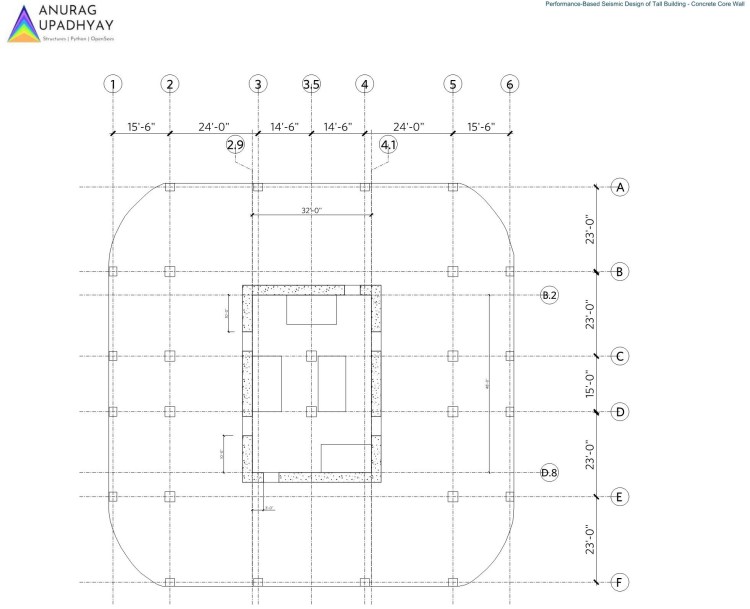
Figure 2 shows a typical structural floor plan of the building. The elevator core consists of planer and L-shaped sections connected by 30-in.-deep coupling beams over doorways that provide access to elevators and stairs. The wall thickness changes at levels 13, and 31. The core has 32-in. thick walls from foundation to level 13, 24-in. thick walls, from level 13 to level 31, and 21-in. thick above level 31. The core wall system is designed using a concrete strength of 8 ksi (28-day) and 60 ksi rebar. Coupling beam reinforcement details are presented in Figure 3 for each direction.
The contents of this course is divided into the following modules. You are expected to read the content thoroughly in the sequence recommended here.
Click on the following links to learn each module.
 Art of Structures